What Is an Asset-Based Carrier?
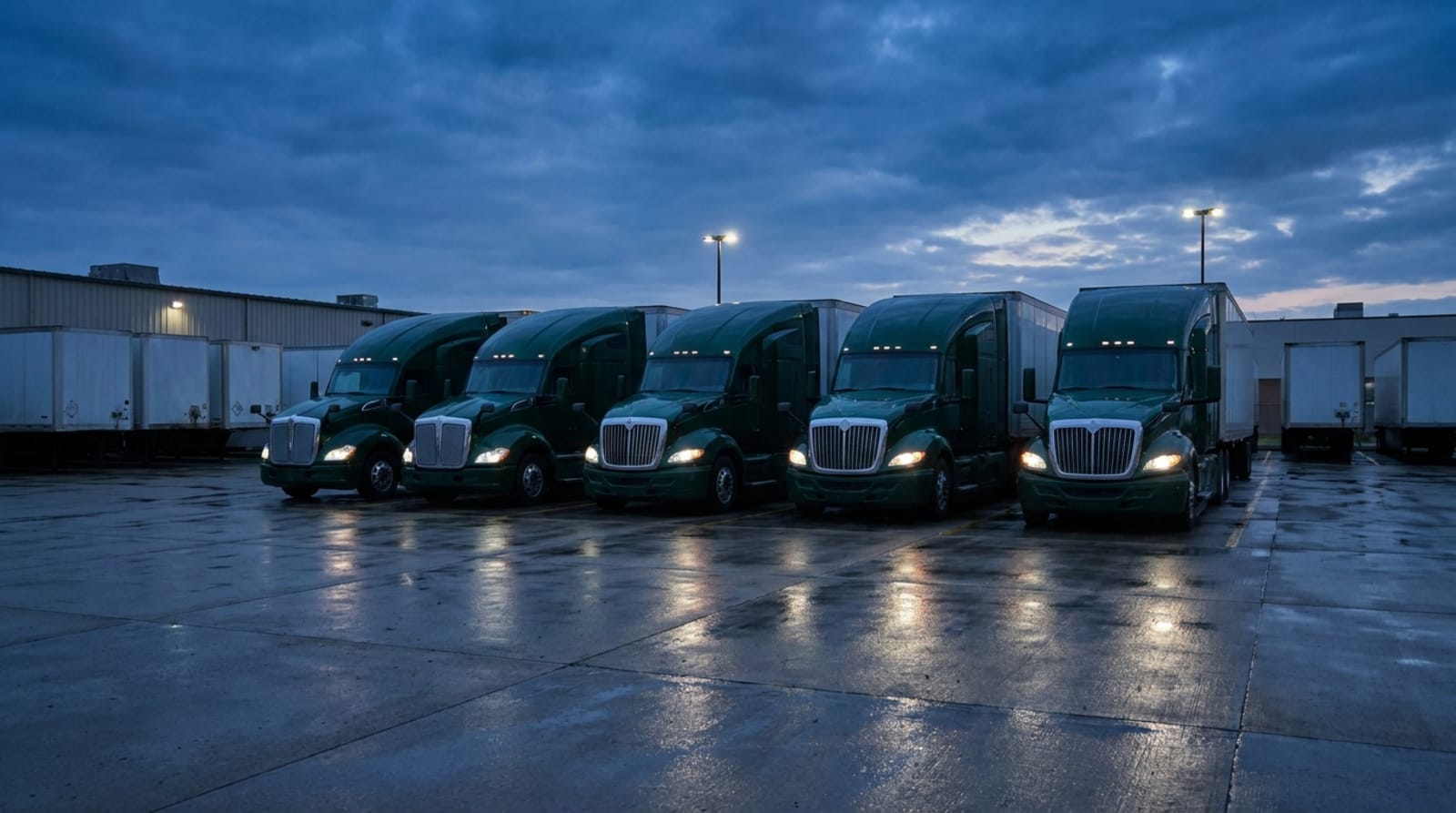
An asset-based carrier is a trucking company that owns its fleet of trucks and trailers and employs its drivers. When you ship with an asset carrier, the company dispatching your load is the same company that owns the truck picking it up. Every driver represents that company. Every trailer carries that company's markings. The carrier's DOT authority covers the entire move.
Asset carriers build their operations around specific equipment types and service areas. A carrier that runs dry van freight in the western United States develops expertise, lane density, and driver relationships in that corridor. That specialization shows up as more reliable transit times, better capacity availability during peak seasons, and drivers who know the routes, the delivery docks, and the local regulations.
Green Lantern Trucking is an asset-owned carrier. Our trucks, our trailers, and our drivers are ours. When you book a load with us, you are booking directly with the company that will pick up, transport, and deliver your freight. Our dispatch team at (619) 625-0147 has visibility into every piece of equipment in our fleet in real time. Learn more about how we operate on our about page.
What Is a Freight Broker?
A freight broker is a licensed intermediary that connects shippers with carriers. The broker does not own trucks. Instead, the broker maintains a network of carrier relationships and, when a shipper needs capacity, matches that load to a carrier willing to move it at an agreed price. The broker earns a margin on the difference between what the shipper pays and what the carrier receives.
Freight brokers are federally licensed and bonded, and the good ones provide real value — particularly for shippers who need access to lanes outside a single carrier's service territory, or who need help finding capacity during high-demand periods. The broker's value proposition is network breadth: access to thousands of carriers across the country through a single point of contact.
The trade-off is visibility and accountability. When a broker books your load, the actual carrier may be an owner-operator with a single truck, a small regional carrier, or anyone in the broker's network who accepted the load at the offered price. You may not know who is moving your freight until the truck is already at your dock. That opacity is not inherently bad, but it is a meaningful difference from working with a carrier you know.
Accountability: Where It Matters Most
The clearest difference between an asset carrier and a broker shows up when something goes wrong. A damaged pallet, a missed delivery appointment, a load that goes off-route — in each case, the asset carrier is the single point of contact and the single responsible party. Their driver, their trailer, their problem to solve. You make one call, and the company that owns the truck picks up the phone.
With a broker, the accountability chain is longer. The broker arranged the load. The carrier that accepted the load is the motor carrier of record. If there is a claim, the broker's liability, the carrier's insurance, and the cargo coverage in your own policy may all be involved. Sorting out who owes what takes time and sometimes lawyers. This is not theoretical — cargo claims are a reality in freight, and the resolution process is genuinely different depending on who moved the load.
This does not mean brokers are irresponsible or that claims are always contentious. It means that for high-value freight, time-sensitive shipments, or loads where you need to know exactly who is operating the vehicle, working directly with an asset carrier reduces complexity. For a practical look at what to expect when freight is damaged or delayed, understanding the difference in carrier accountability is a starting point — our safety and compliance page explains how we manage our fleet and driver standards.
Price: Who Offers Better Rates?
The answer depends on the situation. Brokers with large carrier networks can sometimes offer competitive rates by shopping a load across many carriers simultaneously, driving the price down through competition. In loose capacity markets, when there are more trucks than loads, this works well for shippers.
In tight capacity markets — peak produce season, post-holiday restocking surges, regional weather disruptions — the dynamic reverses. Brokers lose their pricing power because carriers become selective. Asset carriers with established shipper relationships tend to protect those relationships first, giving preferred customers priority access to capacity that might not be available on the spot market at any price.
Over a full year, the cost difference between a direct carrier relationship and a broker relationship is often smaller than shippers expect. Broker margins are real. The savings from competitive bidding may or may not offset those margins, especially when you factor in the cost of service failures — missed appointments, damaged freight, or loads that fall through when a broker cannot find a carrier willing to take the rate. For a deeper look at all the factors that move freight rates, see our post on what drives freight shipping costs.
When a Broker Makes Sense
Brokers serve a real purpose in the freight market. If you have an unusual one-time lane that your primary carrier does not cover, a broker can find capacity quickly. If you are a small shipper with unpredictable freight volume and no leverage to negotiate direct carrier contracts, a broker provides access to rates and capacity you could not access alone. If you need a very specific type of equipment on short notice — an open-deck trailer with a particular configuration, for example — a broker's broad network may source it faster than a single carrier can.
Hybrid approaches are also common. Many large shippers use asset carriers for their core, high-volume lanes where service consistency matters most, and use brokers or freight marketplaces for sporadic, low-priority, or unusual lanes. The key is knowing which lanes deserve the investment in a direct carrier relationship and which do not.
If your freight includes temperature-sensitive commodities, port containers, or oversize equipment, specialty carriers with specific equipment and expertise are almost always preferable to general broker networks. Our reefer shipping guide and the port drayage explained post cover two areas where specialized asset carriers have clear advantages over general-purpose broker networks.
How to Verify Who Is Moving Your Freight
The FMCSA's SAFER system allows anyone to look up a carrier's DOT number, check their authority status, review their safety rating, and verify their insurance. If you are working with a broker, you can request the name and DOT number of the actual carrier assigned to your load before the truck arrives. A reputable broker will provide this without hesitation.
Red flags include brokers who cannot or will not identify the carrier, carriers whose authority is not active in the SAFER system, or situations where the truck that arrives does not match the carrier information you were given. Double-brokering — where a broker passes a load to another broker rather than directly to a carrier — is a known problem in the industry and creates additional accountability gaps.
When you work with Green Lantern Trucking directly, there is no third party to verify. Our authority, our insurance, and our drivers are what show up at your dock. For recurring freight on lanes we cover, a direct relationship eliminates the verification step entirely because you know exactly who is operating the equipment.
Choosing What Is Right for Your Business
For most shippers with recurring freight on defined lanes, a direct relationship with an asset-based carrier delivers better long-term value than relying on brokers for core volume. The accountability is cleaner, the service is more consistent, the carrier learns your freight characteristics over time, and the relationship has real value when capacity gets tight.
The practical question is whether the carrier you are considering actually serves your lanes well. A carrier with strong density in your primary corridors will outperform a larger carrier that treats your lane as a low-priority backhaul. Green Lantern Trucking is built around Southern California as a hub, which makes us a strong primary carrier for freight moving in and out of the Southwest. Our coverage page details where we operate with the highest frequency.
To discuss whether a direct carrier relationship with Green Lantern Trucking makes sense for your freight program, reach our team at (619) 625-0147 or submit a quote request. We serve all 48 contiguous states with FTL, LTL, reefer, flatbed, and dedicated lane service from our headquarters at 18616 Bee Canyon Road, Dulzura, CA 91917. For shippers evaluating their shipping mode options alongside carrier type, our post on FTL vs LTL: how to choose is a useful companion read.