What Is a Dry Van Trailer?
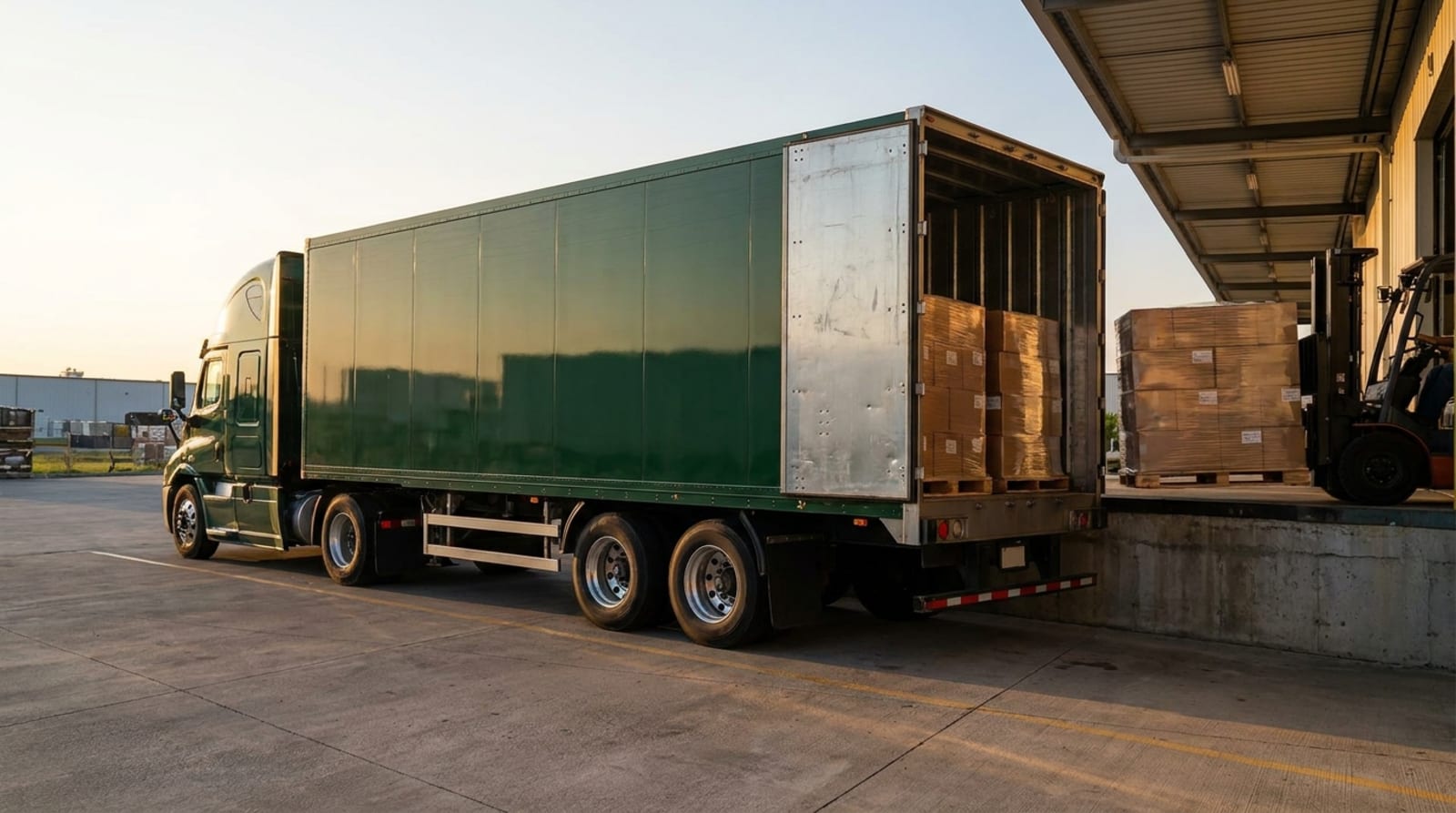
A dry van trailer is an enclosed, box-shaped trailer attached to a semi-truck. The walls, roof, and floor are solid, which means freight inside is protected from rain, wind, dust, and road debris. The trailer is not refrigerated — 'dry' simply means unrefrigerated, not that the trailer is arid or specially conditioned. Inside, temperature tracks ambient conditions with some buffering from the insulated walls.
Standard dry van trailers in North America are 53 feet long, 8.5 feet wide, and approximately 9 feet tall internally. That space accommodates roughly 26–28 standard 48-inch by 40-inch pallets depending on stacking height and freight density. Trailers are loaded and unloaded through rear swing doors, and most have provisions for load bars and straps to secure freight during transit.
The simplicity of the dry van is also its strength. Because it is the dominant trailer type in the country, equipment is widely available, docks are universally set up to handle it, and the operational processes around dry van shipping are well understood by carriers, shippers, and receivers alike. When your freight fits a dry van, there is no reason to complicate it.
What Freight Ships in a Dry Van?
The range of freight that moves in dry van trailers is enormous. Consumer packaged goods — beverages, household products, packaged food, electronics, apparel — are the core. Industrial products like auto parts, building materials, paper products, and manufactured goods make up another large segment. Non-perishable food items, retail merchandise, and e-commerce inventory round out the picture.
Dry van is appropriate when your freight does not require temperature control, does not exceed the trailer's dimensional limits, and does not need to be loaded from the top (as flatbed allows). If your product is sensitive to moisture, make sure it is packaged to handle condensation — while a dry van protects from direct weather, humidity can still be a factor in certain corridors and seasons.
- Consumer packaged goods (CPG): beverages, household items, packaged food
- Electronics and technology equipment (boxed and palletized)
- Auto parts and components
- Building materials that fit within trailer dimensions
- Paper and printing products
- Retail and e-commerce inventory
- Non-perishable food and grocery items
- Industrial and manufacturing components
Dry Van vs. Other Trailer Types
Choosing the right trailer type starts with understanding what each one does. Dry van is the baseline — enclosed, unrefrigerated, standard-dimensional. Reefer trailers add temperature control for perishable freight, at higher cost. Flatbed trailers have no walls or roof, which allows top and side loading and accommodates oversized or irregularly shaped loads that cannot fit through a trailer door.
If your freight requires a temperature-controlled environment, dry van is not the answer regardless of price. Our post Reefer Shipping 101 covers how temperature-controlled freight works and what shippers need to plan for. If your freight is oversized, irregularly shaped, or needs to be loaded by crane, visit our Specialized Services page to understand flatbed and heavy haul options.
Some shippers default to dry van because it is familiar, even when another trailer type would serve them better. A brief conversation with your carrier about what you're actually shipping — dimensions, weight, temperature sensitivity, and loading method — gets you to the right equipment faster than assuming dry van is always the answer.
FTL vs. LTL Dry Van
Within dry van shipping, the next choice is full truckload (FTL) or less-than-truckload (LTL). FTL dedicates an entire trailer to your shipment. The truck goes from your pickup location to your delivery location with no stops in between. Your freight is not handled again after it is loaded. FTL is faster, involves less handling, and is better suited for high-value, fragile, or time-sensitive freight.
LTL consolidates your freight with other shippers' loads on the same trailer. Your shipment is picked up, moved to a terminal, potentially transferred to another trailer, and delivered as part of a multi-stop route. LTL costs less per shipment for smaller loads but adds transit time and handling. Damage rates on LTL freight are higher than on FTL because of the additional transfer points.
The right choice depends on your shipment size, timeline, and how much handling your freight can handle. Our post FTL vs. LTL: How to Choose walks through the decision systematically. For rate context, our FTL & LTL services page covers what Green Lantern Trucking offers on both.
How Dry Van Rates Are Priced
Dry van rates reflect distance, weight, freight class, lane supply and demand, fuel costs, and timing. A load moving on a high-volume lane between two major markets will generally price more competitively than the same load moving on a thin, rural lane. Loads tendered with short lead time may carry a premium. Fuel surcharges adjust rates with diesel price fluctuations.
Freight class — the NMFC classification system — affects LTL pricing significantly. Higher-class freight costs more per hundredweight because it is denser, more fragile, or more hazardous. For FTL, freight class matters less because you are paying for the trailer regardless of what fills it. Our post Understanding Freight Class and NMFC explains how the classification system works and how to make sure your freight is classified correctly.
For a broader picture of what drives your freight bill, read What Drives Freight Shipping Costs. Understanding the underlying cost drivers lets you have a more productive conversation with your carrier and helps you spot pricing that is out of line with market conditions.
Preparing Your Freight for Dry Van Pickup
Dry van freight should be palletized, stretch-wrapped, and labeled before the truck arrives. Loose product, unstable pallets, and missing labels slow down loading and create problems at delivery. Your driver should not have to build or repair pallets at pickup — that is a shipper responsibility, and most carriers will note non-conforming freight on the bill of lading.
Pallet weight and height limits matter for dry van loading. Gross pallet weight for standard 48x40 pallets is typically capped at 2,500 lbs, and stacking height is limited by trailer clearance. Overweight or over-height pallets may not be loadable, or they may require specific positioning in the trailer. If you have any question about whether your pallets meet standard requirements, confirm before the truck shows up.
Our post How to Prepare a Shipment for Pickup covers palletization, labeling, BOL requirements, and what to have ready when the driver arrives. Getting the preparation right upfront prevents delays, damage claims, and billing disputes downstream.
Booking Dry Van Service with Green Lantern Trucking
Green Lantern Trucking operates dry van equipment across all 48 contiguous states. We are an asset-owned carrier — we own the trucks and trailers, employ the drivers, and control the service from pickup through delivery. There is no brokerage layer between you and the people actually moving your freight.
Our dispatch team is available 24/7 at (619) 625-0147. To get a quote, visit our online quote form or call us directly. Have your origin and destination, shipment dimensions and weight, freight class if known, and desired pickup date ready. We will come back with a direct answer on availability and rate — no runaround.
If you want to understand the full range of what Green Lantern Trucking offers beyond dry van — reefer, flatbed, drayage, dedicated lanes — visit our Services page. We are headquartered at 18616 Bee Canyon Road, Dulzura, CA 91917, but we serve shippers across the country, not just those in Southern California.