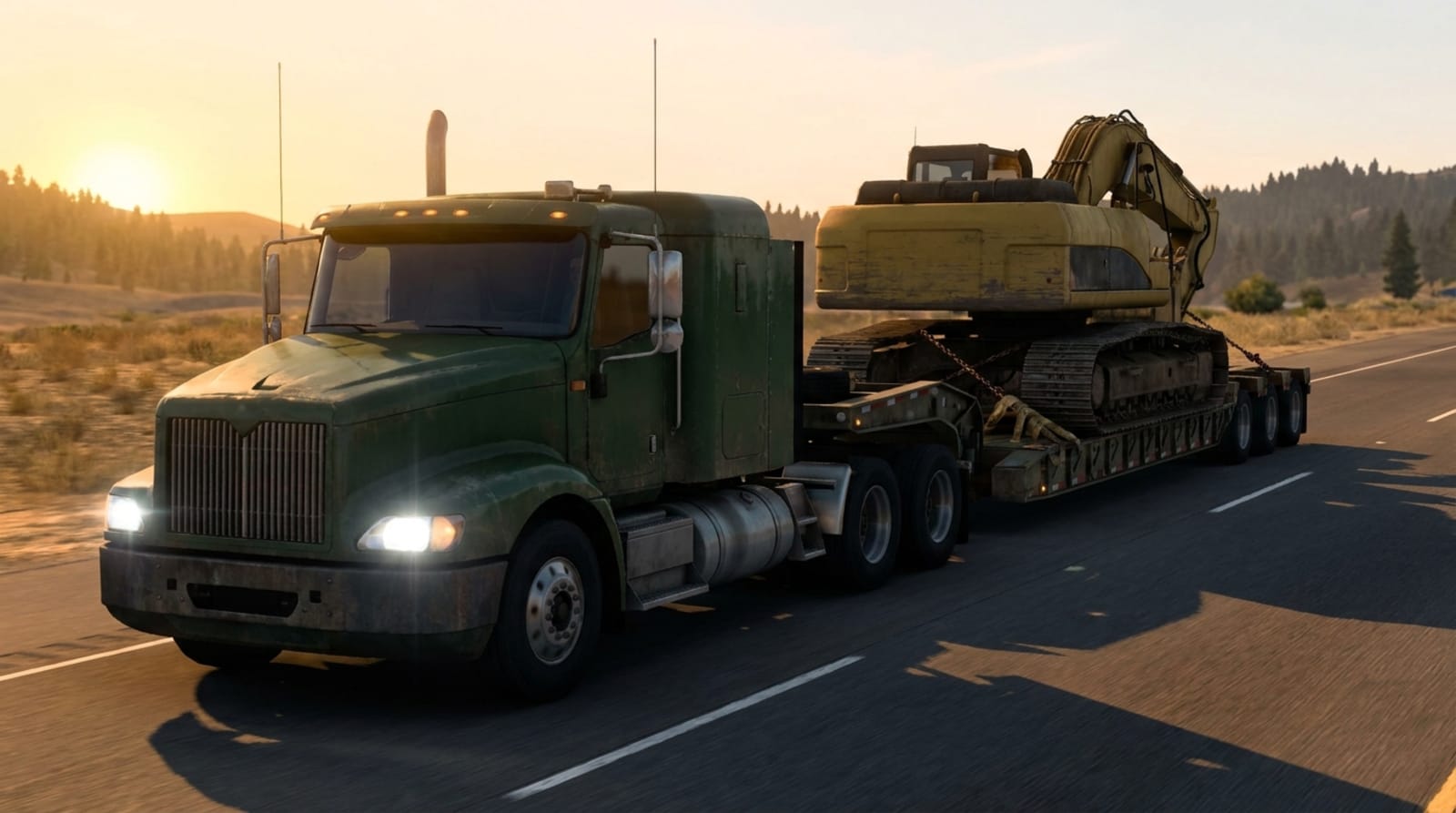
What Qualifies as Heavy Haul Freight?
Heavy haul is a broad category that covers any freight that exceeds standard legal limits for weight, width, height, or length — or freight that simply requires an open-deck trailer because of its shape or size. Common examples include construction equipment such as excavators, bulldozers, and graders; agricultural machinery including combines and planters; industrial generators and transformers; modular building sections; and large structural steel or manufactured components.
The defining characteristic is not just weight — it is the combination of dimensions and mass that determines what permits are needed, what routes are available, and what equipment is required. A wide load that is legally weighted still needs an escort. An overweight load that fits within width limits needs a different set of permits. Each dimension and weight threshold triggers its own regulatory layer.
If you are not sure whether your freight qualifies as oversize or overweight, the general federal benchmarks are a useful starting point: 8 feet 6 inches wide, 13 feet 6 inches tall, 53 feet long, and 80,000 pounds gross vehicle weight (including the tractor and trailer). Anything that exceeds those numbers requires permits in most states, and some states set lower thresholds. Your carrier's permit department should handle the specifics, but knowing the framework helps you ask the right questions.
Choosing the Right Trailer for Your Equipment
Flatbed trailers are the workhorse of the heavy haul industry. A standard flatbed is 48 to 53 feet long, 8.5 feet wide, and rides at approximately 5 feet off the ground. They are the right call for equipment that is within legal height limits and does not require a dropped deck for loading. Wheeled equipment like skid steers, compact excavators, and trailers can often load and unload under their own power on a flatbed.
Step-deck trailers — also called drop-deck trailers — have a higher front section and a lower rear section, giving you an extra foot to foot-and-a-half of vertical clearance for taller equipment. If your machine is between 10 and 11.5 feet tall, a step-deck keeps you legal in most states without a height permit. Lowboy trailers take this further, dropping the deck to as low as 18 inches off the ground. Lowboys are the standard for the tallest, heaviest equipment — large excavators, cranes, and mining machinery.
Specialized trailers exist beyond these three main types: removable gooseneck (RGN) trailers that allow equipment to drive on from the front, multi-axle trailers for extreme weights, and extendable trailers for unusually long loads. Green Lantern Trucking's heavy haul service covers the full spectrum of open-deck equipment. Our team will help you identify the right trailer type before you commit to a quote.
Permits: What You Need and How to Get Them
Oversize and overweight permits are issued by individual states, and every state your load travels through requires its own permit. A move from San Diego to Houston crosses California, Arizona, New Mexico, and Texas — four separate permit applications, four sets of fees, and four potential sets of route restrictions. Some states require specific routes, prohibit travel during certain hours (often Friday afternoons and weekends), or require travel only during daylight.
Your carrier's permit department handles the applications, but you need to provide accurate dimensions and weights to start the process. Gross vehicle weight includes the tractor, the trailer, and the cargo. Measure width at the widest point including any protruding attachments. Measure height from the ground to the highest point of the load. Measure length from the front of the tractor to the rear of the cargo, not just the equipment itself.
Lead times for permits vary. Routine oversize permits in most states can be obtained in one to two business days. Superload permits — for extreme weights, typically over 150,000 pounds — may require engineering reviews, bridge analyses, and coordination with state DOT officials that can take two to three weeks or more. Plan your timeline accordingly and contact your carrier well in advance of your target move date.
Securement Requirements and Your Role as Shipper
Federal Motor Carrier Safety Administration (FMCSA) regulations in 49 CFR Part 393 govern cargo securement on commercial vehicles. The driver is legally responsible for securing the load, but shippers play a critical role in providing equipment that can be secured — tie-down points, blocking, and bracing — and in not loading in a way that makes proper securement impossible.
For heavy equipment, securement typically involves chains rated to the Working Load Limit (WLL) required for the cargo weight, binders to tension the chains, and blocking or chocking to prevent the equipment from rolling or shifting. Machinery with buckets, blades, or other moving components must have those components lowered and pinned or chained separately. Hydraulic systems should be locked or relieved of pressure before transport.
Before your pickup date, drain any excess fuel from the equipment tanks to the minimum safe operating level — many states restrict fuel in tanks on transported equipment to reduce fire risk and overall weight. Retract any antennas, mirrors, or attachments that could become projectiles or add unauthorized width to the load. Clear communication between the shipper, the loading crew, and the driver before chains go on prevents problems that would otherwise be discovered at a weigh station.
Route Planning and Pilot Car Requirements
Oversize loads do not just use any available route. Low bridges, narrow roadways, overhead utilities, and weight-restricted roads all factor into the permitted route, which may differ significantly from the most direct path. In some cases, state permit offices designate the exact route your load must follow. Deviating from a permitted route is a violation even if the alternate path looks clear.
Pilot cars — also called escort vehicles — are required when a load exceeds certain width and length thresholds. Requirements vary by state, but a common rule of thumb is that a single rear escort is required for loads over 12 feet wide, and both a front and rear escort are required over 14 feet wide. Some states require law enforcement escorts for the widest or heaviest loads. Your permit department will specify what is required on each segment of your route.
For complex or multi-state moves, a route survey conducted by a professional pilot car service before the actual move is money well spent. The survey identifies problems — a low tree branch that was not on any map, a recently repaved road with reduced clearance — that could stop your move in progress and require expensive rerouting or delays.
Loading and Unloading: Planning for Both Ends
The loading site and delivery site both need to be evaluated before booking. Is the road to the loading site paved and rated for the combined weight of the loaded trailer? Is there enough turning radius for a tractor-trailer? Is the equipment stored in a location where a lowboy or flatbed can reach it, or does it need to be moved with an on-site crane or forklift? These questions sound basic, but failing to ask them causes expensive delays on move day.
At the delivery site, the same questions apply. If the equipment is going to a job site that has not yet been graded, confirm the ground conditions are firm enough to support the trailer under load. Soft ground can swallow axles. If the equipment needs to be offloaded onto a surface that the trailer cannot reach directly, plan for a crane lift or an intermediate staging area.
Green Lantern Trucking's drivers and dispatch team work through these logistics before the move, not on the day of. For loads that involve complex site conditions or multi-piece equipment moves, early coordination between your operations team and ours prevents the kind of surprises that turn a one-day job into a three-day standstill. Reach our team at (619) 625-0147.
Finding the Right Heavy Haul Carrier
Heavy haul is a specialty. Not every trucking company has the equipment, the permit expertise, or the driver experience to handle oversize and overweight freight. When evaluating carriers, ask specifically about their flatbed and open-deck fleet, their in-house permit department, and their experience with the type of equipment you are moving. A carrier that routinely handles excavators and generators has different capabilities than one that occasionally picks up a wide load on a standard flatbed.
Asset-based carriers — those who own their own trailers rather than relying on owner-operators or third-party brokers — give you more control over equipment condition and driver accountability. When a flatbed is owned by the carrier, it is maintained to the carrier's standards, inspected regularly, and operated by drivers who know that equipment. That matters for something as consequential as an oversize load on a state highway.
For a broader look at how asset carriers compare to brokers in terms of accountability and service, read our post on asset-based carrier vs freight broker. To discuss a specific heavy haul move with Green Lantern Trucking, call us at (619) 625-0147 or fill out our quote request form. We serve all 48 contiguous states from our headquarters in Dulzura, California.