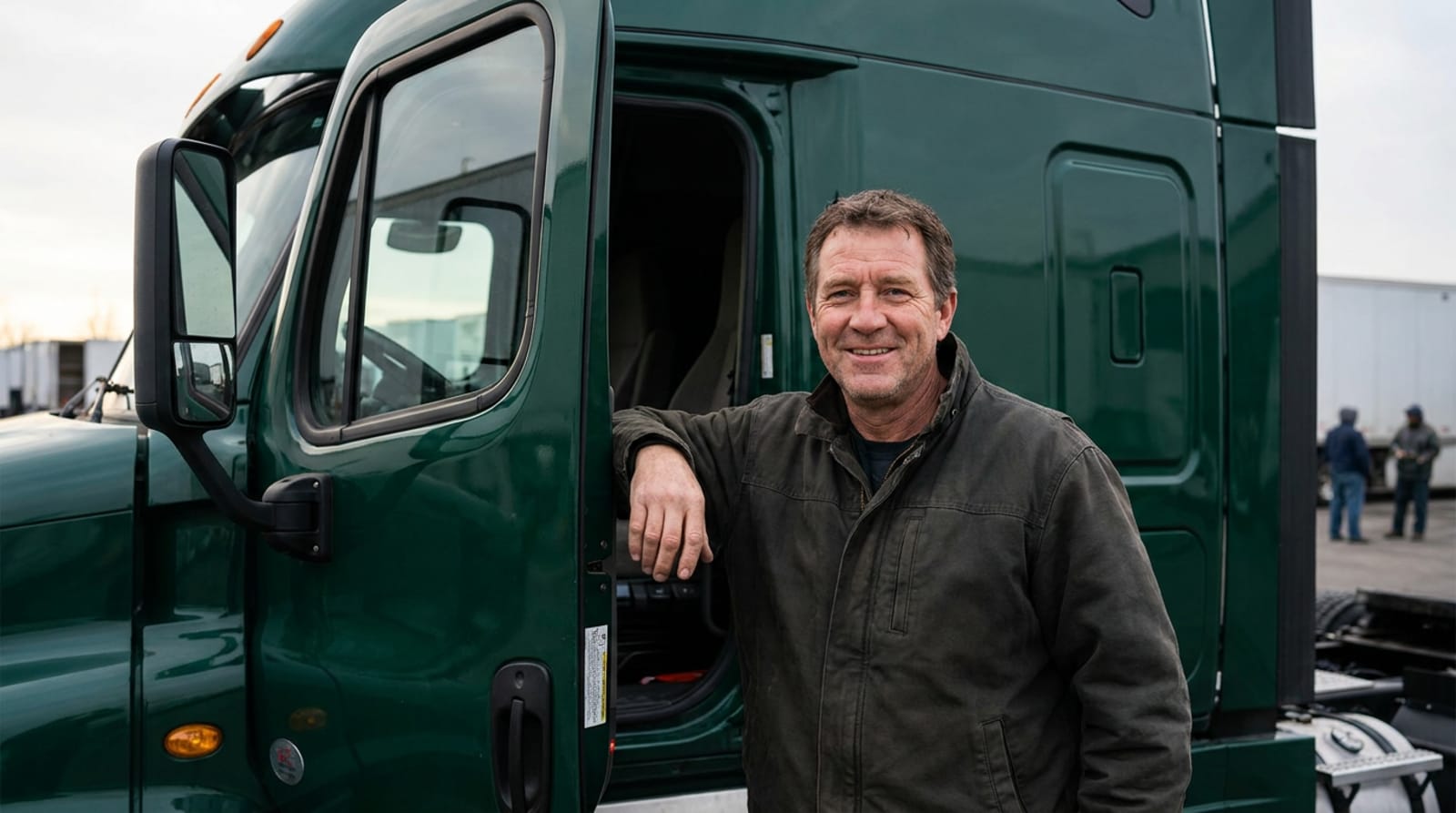
Asset Carrier vs. Other Driving Arrangements
When you start evaluating driving jobs, you will encounter several types of arrangements: company driver positions at asset carriers, owner-operator leasing to brokerages, and independent authority running spot freight. Each has different risk and reward profiles. Driving as a company driver for an asset carrier is generally the most stable option — the carrier owns the truck, handles maintenance, pays for fuel or reimburses it, and provides a consistent freight base.
At an asset carrier, you are an employee (or contracted company driver) working with equipment the carrier owns and maintains. The freight is largely committed — the carrier has shipper relationships and contracts, not just spot market loads. That means your truck is more likely to be loaded and moving rather than sitting idle waiting for a load to come in from a load board.
Contrast that with leasing your truck onto a brokerage, where you own or lease the equipment but depend on the brokerage to find your loads. When spot market rates drop, your income drops with them. When the brokerage loses a customer, so do you. An asset carrier absorbs those market swings internally and keeps drivers running. For a broader look at the asset vs. broker distinction, our post on asset carrier vs. freight broker explains the business model differences in detail.
CDL-A License Requirements and Endorsements
A CDL-A (Commercial Driver's License Class A) is the baseline requirement for driving combination vehicles — a tractor plus a trailer. To obtain your CDL-A, you must pass a knowledge test, a pre-trip inspection test, a basic vehicle control test, and an on-road driving test at a state licensing office. Most states also require a medical certificate from a DOT-approved physical examination.
Endorsements expand what you are legally allowed to haul. Common endorsements that increase your value as a driver include the Hazmat (H) endorsement for regulated materials, the Tanker (N) endorsement for liquid bulk, and the Doubles/Triples (T) endorsement for multi-trailer combinations. Reefer driving does not require a specific endorsement but benefits from experience — temperature management, pre-cooling, and in-transit monitoring are skills developed on the job.
Flatbed and heavy haul driving, which Green Lantern Trucking provides through our specialized freight services, typically requires experience with load securement, tarping, and in some cases oversize/overweight permitting. These skills make a driver significantly more versatile and open up higher-paying load types.
Pay Structure: How Drivers Earn at Asset Carriers
Most company driver positions at asset carriers pay on a cents-per-mile basis. The rate varies by carrier, region, lane type, and driver experience. Mileage pay is supplemented by additional line items: stop pay compensates drivers for each delivery or pickup stop beyond the first, detention pay compensates for time spent waiting at a shipper or receiver beyond a defined free time window, and layover pay covers situations where a driver is held away from home due to no fault of their own.
Dedicated lane drivers often receive a different pay structure than over-the-road (OTR) drivers. Because dedicated lanes run fixed routes on predictable schedules, some carriers pay a weekly or per-run flat rate rather than strict mileage pay. This can be advantageous if the lane involves a lot of urban driving with slower speeds — flat pay does not penalize you for city traffic the way pure mileage pay does.
- Mileage pay: The base rate, paid per practical mile driven.
- Stop pay: Additional pay per pickup or delivery stop.
- Detention pay: Compensation for waiting at docks beyond free time.
- Layover pay: Daily rate when held away from home unexpectedly.
- Safety bonuses: Many carriers offer quarterly or annual bonuses tied to clean safety records.
Home Time: OTR, Regional, and Dedicated
Home time is one of the most important factors drivers evaluate when choosing a carrier. It varies significantly by lane type. Over-the-road (OTR) drivers running coast to coast typically get home every one to three weeks depending on the carrier and lane structure. For drivers who prioritize income and don't mind extended time away, OTR offers high mileage and consistent loads.
Regional drivers run within a defined geographic zone — the West Coast, the Southwest, the Southeast — and typically get home weekly or more frequently. The lanes are shorter, which means more pickup and delivery activity per week, but also more time in familiar territory. Dedicated lane drivers often have the most predictable schedules because the routes and days are fixed in advance.
Green Lantern Trucking operates lanes across all 48 contiguous states from our San Diego base. Our network includes both long-haul OTR runs and shorter regional corridors, particularly in the Southwest and West Coast. If home time is a priority for you, let us know when you apply — our team works to match drivers with lanes that fit their schedule needs. Visit our careers page to see current openings.
Safety, HOS, and Compliance
Hours of Service (HOS) rules are federal regulations that govern how long a CDL-A driver can drive and work in a given period. The current rules limit driving to 11 hours within a 14-hour on-duty window, with a mandatory 10-hour off-duty period between shifts. A 30-minute break is required after 8 consecutive hours of driving. A 34-hour restart provision allows resetting the 60/70-hour weekly limit.
Electronic Logging Devices (ELDs) automatically record driving time and HOS data, replacing paper logs. Every commercial vehicle over 10,000 lbs. GVWR operating in interstate commerce is required to use an ELD. For drivers, this means there is no manual flexibility around hours — the clock is running whether you are moving or waiting at a dock. Managing your time to avoid unnecessary detention is a practical skill that experienced drivers develop.
Your safety record — violations, accidents, and CSA scores — follows you throughout your career. Carriers check the FMCSA's Pre-Employment Screening Program (PSP) record during hiring. A clean record opens doors; a pattern of violations closes them. Green Lantern Trucking takes safety seriously and expects drivers to do the same. Our safety commitment page outlines the standards we hold ourselves and our drivers to.
What Life on the Road Actually Looks Like
A typical OTR day starts with a pre-trip inspection — checking lights, tires, brakes, coupling hardware, and fluid levels. This is not optional; it is a federal requirement and the first line of defense against mechanical breakdowns and compliance violations. Experienced drivers build the inspection into their morning routine and do it the same way every time.
Driving time is structured around the HOS clock. Most drivers plan fuel stops, weigh station compliance, and rest breaks around their 14-hour window. Meal planning, cab organization, and maintaining a sleep schedule that accommodates odd hours are practical skills that matter more than they might seem when you are three weeks into a stretch away from home.
Shippers and receivers do not always run on the driver's schedule. Dock delays, appointment windows, and warehouse backlogs mean drivers spend meaningful time waiting. Learning to use that time productively — resting, completing paperwork, planning the next leg — is part of the job. Green Lantern Trucking's 24/7 dispatch means a driver can reach someone at any hour if a situation changes on the road. That kind of support makes a real difference when you are sitting at a receiver at 2 AM trying to figure out a schedule change.
Why Drive for Green Lantern Trucking
Green Lantern Trucking is an asset-owned freight carrier headquartered in Dulzura, CA — San Diego County. We serve all 48 contiguous states and run a range of freight types: dry van, reefer, flatbed and heavy haul, and port drayage. Our drivers work with equipment we own and maintain, not leased or brokered trucks. When something needs fixing, it gets fixed — we are not waiting on a third party to authorize a repair.
Our tagline is "Freight that always finds the light." That applies to how we treat drivers too. Consistent lanes, 24/7 dispatch support, and a management team that has been in this industry long enough to understand what drivers need to do their jobs well. We are growing and actively hiring CDL-A drivers for multiple lane types across our network.
If you have your CDL-A and are looking for a company that owns its equipment, controls its freight, and treats its drivers as professionals, we want to hear from you. Call us at (619) 625-0147 or visit our CDL-A careers page to apply. You can also learn more about the freight we run on our services page.