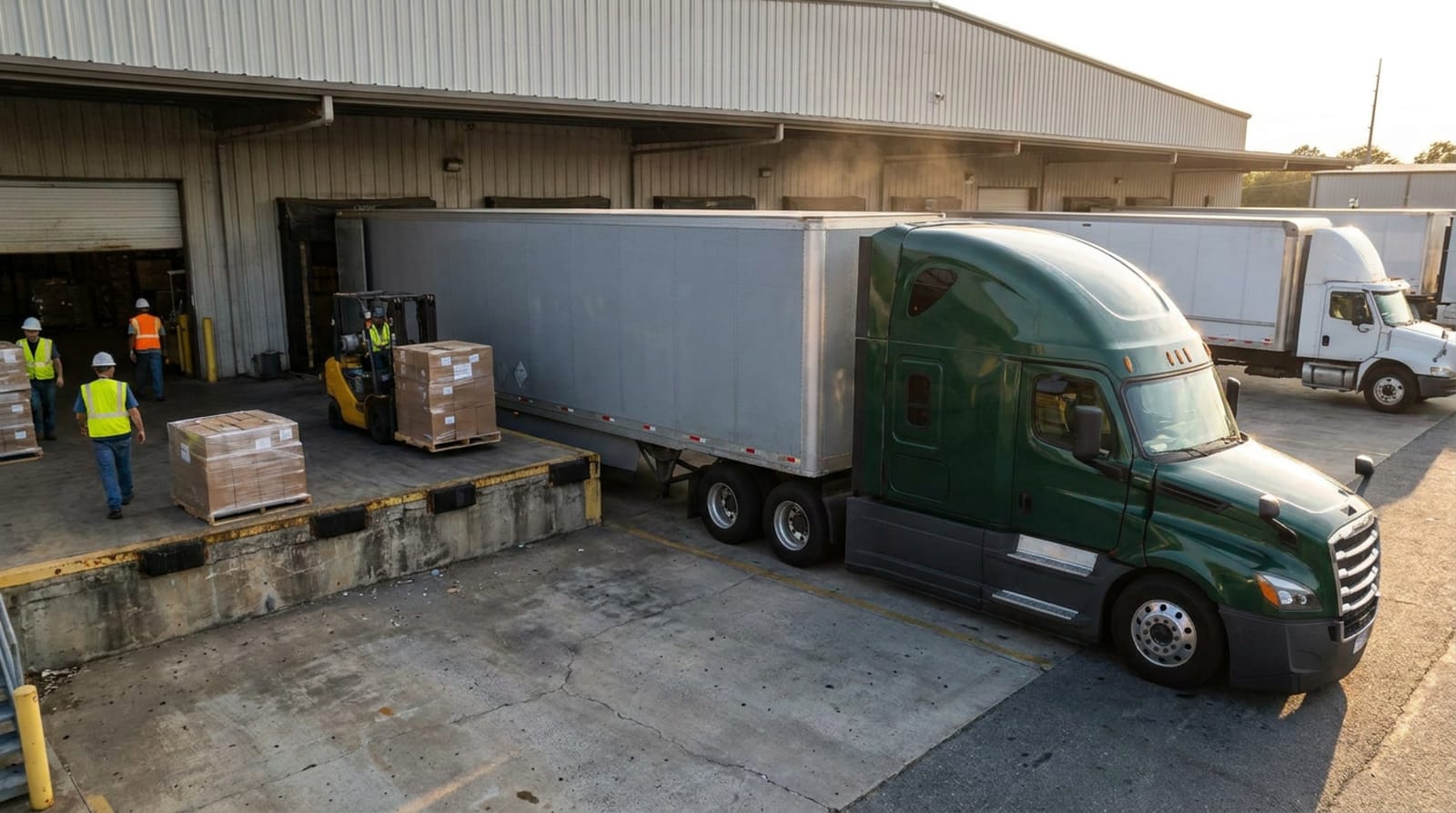
Distance and Lane: The Foundation of Every Rate
Every freight quote starts with the lane — where the freight is moving from and to. Distance is the most obvious cost driver: a 300-mile move costs less than a 2,000-mile move, all else being equal. But lane is about more than raw mileage. Carrier density, meaning how many trucks regularly run a given corridor, matters just as much. High-volume lanes like Los Angeles to Chicago are competitive and often cheaper per mile than low-density lanes in rural markets.
Imbalance in a lane also affects price. If more freight moves east than west on a given corridor, carriers running west to reposition empty equipment will discount aggressively to pick up any load that helps them avoid a deadhead. Understanding directional imbalance in your primary lanes is one of the first steps toward smarter rate negotiation.
Green Lantern Trucking operates out of San Diego, which places us at the hub of one of the busiest freight corridors in the country — the Southern California to the rest of the nation lane. Our coverage and service areas page details the regions we serve most consistently. For shippers moving freight in or out of San Diego specifically, our post on shipping freight out of San Diego explains the local market dynamics.
Weight, Density, and Freight Class
For LTL shipments, freight class is the single biggest variable in the rate calculation beyond distance. The National Motor Freight Classification (NMFC) system assigns a class from 50 to 500 to every commodity based on four factors: density, stowability, handling difficulty, and liability. A class 50 commodity — dense, easy to stack, low liability — rates cheaply. A class 300 commodity takes up space, is hard to handle, and carries higher risk, so it rates expensively.
Density is the most controllable of the four factors. Freight that is poorly packaged — large boxes with a lot of air inside, or pallets that are not stacked efficiently — can be reclassified upward at the carrier's discretion after pickup. That reclassification triggers an additional charge that often surprises shippers. Measure and weigh every shipment accurately, and pack to maximize density within your packaging constraints.
For FTL shipments, class matters less because you are paying for the trailer, not for space consumed. Weight still matters — legal road weight limits cap most loads at around 44,000 to 45,000 pounds of freight on a standard five-axle combination. Going over legal weight requires oversize permits and specialty routing. For loads that push or exceed those limits, see our heavy haul service for options.
Fuel Surcharges: How They Work and Why They Matter
Fuel surcharges are not a carrier's profit center — they are a cost pass-through mechanism tied to the weekly U.S. Energy Information Administration (EIA) diesel retail price index. When diesel prices rise, surcharges rise with them. When prices fall, surcharges fall. Most carriers publish a surcharge table that maps the EIA price to a per-mile or percentage-based surcharge applied to the base rate.
On a long-haul FTL move, fuel can represent a significant share of the total invoice. That is why shippers who lock in dedicated lane agreements sometimes negotiate fuel surcharge caps or use index-based pricing that smooths out spikes. Spot market shippers absorb the full market rate. If your freight spend is large enough, understanding your carrier's fuel surcharge methodology and comparing it across vendors is worth the effort.
There is no way to eliminate fuel surcharges, but you can reduce their impact by consolidating shipments to reduce total miles, choosing direct lanes over indirect routing, and negotiating base rates that account for current fuel levels rather than older benchmarks.
Market Capacity: The Factor Shippers Often Overlook
Beyond your specific shipment characteristics, the broader truckload market affects what you pay. Capacity — the ratio of available trucks to available loads — fluctuates with seasons, economic cycles, weather events, and regulatory changes. When capacity is tight, carriers can be selective and rates rise. When capacity is loose, shippers have negotiating leverage and spot rates soften.
Seasonal patterns are relatively predictable. Freight demand typically peaks in the fall ahead of the holiday retail push, and again in spring as produce season kicks off in California and the Southwest. Planning your heaviest shipments outside these windows — or locking in capacity through contract agreements before peak season — can meaningfully reduce what you pay.
Working directly with an asset-based carrier rather than a broker gives you more visibility into actual capacity. A carrier that owns its trucks knows what equipment it has available. A broker is working secondary markets and may face limited options during tight periods. For a deeper look at how carrier type affects your supply chain, read our post on asset-based carrier vs freight broker.
Accessorial Charges: The Hidden Line Items
Accessorial charges are fees for services beyond standard pickup and delivery at a dock-height facility during business hours. They are not hidden in any deceptive sense — they are listed in every carrier's tariff — but shippers who do not plan for them consistently get surprised by their invoices.
- Liftgate: Required when the pickup or delivery location does not have a dock. Added at both origin and destination if applicable.
- Residential delivery: Any address that is zoned residential or functions like one triggers this fee.
- Inside delivery: Carrying freight beyond the threshold or tailgate.
- Detention: Charged when a driver waits beyond the free time allowance at pickup or delivery — typically two hours.
- Redelivery: If no one is available to receive the shipment and the driver has to return.
- Overlength / overweight: For freight that exceeds standard parameters.
- Hazmat handling: For regulated materials requiring special documentation and placarding.
The best way to control accessorial costs is to communicate accurately when you book. Tell your carrier about dock availability, operating hours, any equipment needed at delivery, and whether the consignee will be ready to unload promptly. Accurate information upfront prevents charges that show up after the fact.
How Equipment Type Affects Your Rate
Not all trailers cost the same to operate. Reefer units carry refrigeration equipment that burns diesel even when the truck is parked, so reefer rates are consistently higher than dry van rates. Flatbed loads require special securement equipment, tarps, and more driver labor to load and unload, which is reflected in the rate. Open-deck moves for oversize equipment carry the added cost of permits, pilot cars, and route surveys.
Choosing the right equipment type for your freight is not just a safety question — it is a cost question. Dry van is the least expensive option and appropriate for the vast majority of general freight. If your freight does not require temperature control or an open deck, defaulting to dry van keeps costs down. For seasonal produce, pharmaceuticals, or other temperature-sensitive goods, a reefer is not optional, but understanding the premium helps you plan your landed cost correctly.
Green Lantern Trucking operates dry van, reefer, and flatbed equipment from our San Diego base. Whether you are moving a standard pallet of general freight or a piece of industrial machinery, our team can match you to the right trailer. View the full range of options on our services page or contact us at (619) 625-0147.
Practical Steps to Lower Your Freight Spend
The most effective cost reduction strategies are also the most straightforward. First, provide accurate shipment data every time — correct weight, dimensions, and freight class. Carriers price for what you tell them. If the actual freight is heavier or classed differently than quoted, you will pay the difference plus a reweigh or reclassification fee. Accuracy is free; corrections are not.
Second, build consistent volume with a carrier you trust. Spot market booking is convenient but expensive over time. Carriers value reliable shippers who provide regular freight, pay on time, and communicate well. That relationship has real dollar value that shows up in rate negotiations, capacity availability during tight markets, and priority service during disruptions.
Third, look at your shipping schedule. Freight picked up Monday through Wednesday generally has more available capacity than Friday pickups. Flexible delivery windows reduce the carrier's cost and can be reflected in a lower rate. If you are curious about how FTL and LTL costs compare for your specific freight profile, read our post on FTL vs LTL: how to choose. To get a direct quote from Green Lantern Trucking on any lane you are running, use our online quote form.