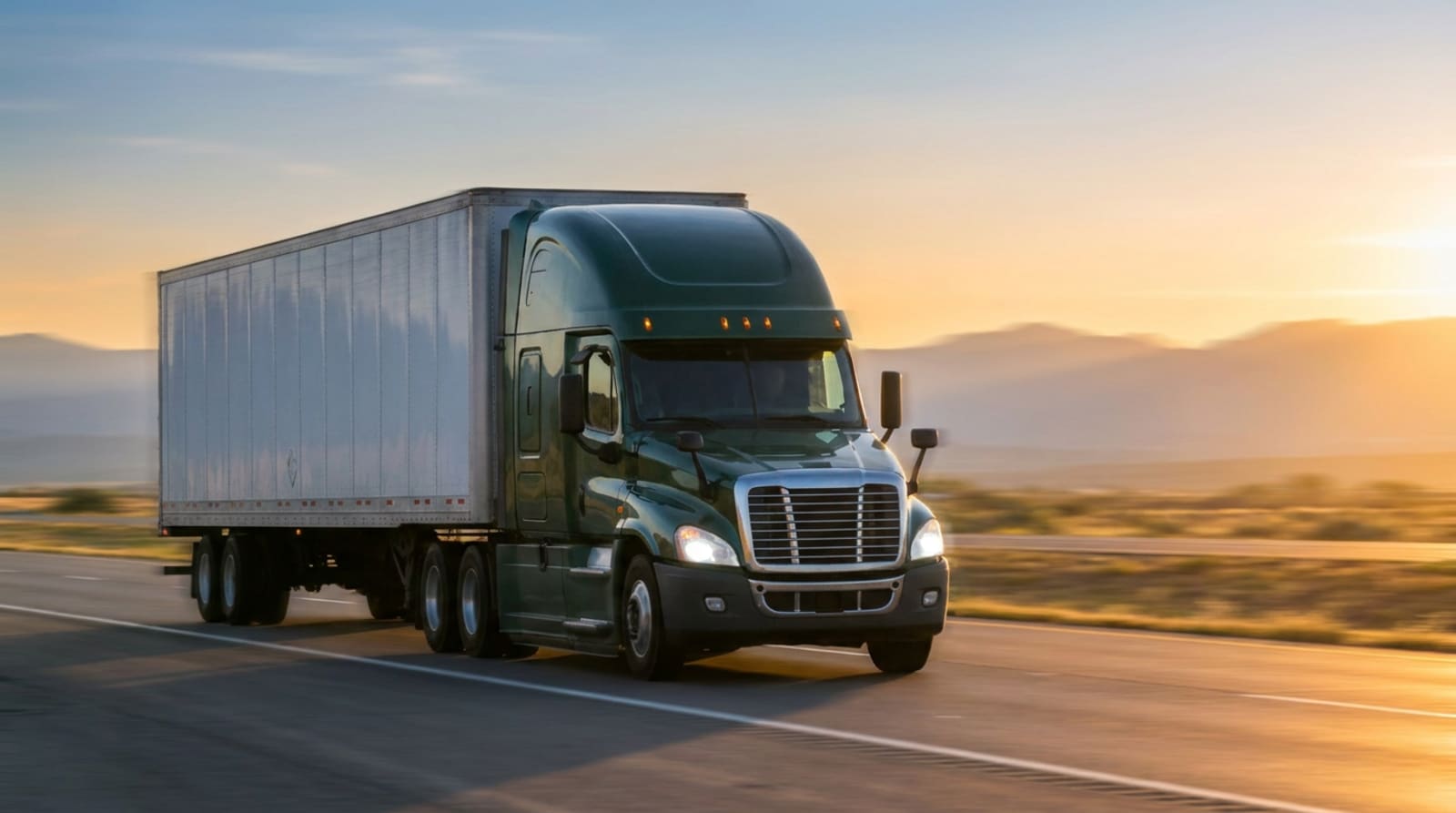
What Is Full Truckload (FTL) Shipping?
Full truckload shipping means your freight occupies an entire trailer — a standard 53-foot dry van, a reefer unit, a flatbed, or another equipment type — exclusively. The truck goes from your origin to your destination without stopping to pick up or drop off other shippers' cargo. You pay for the whole trailer whether it is completely full or not.
FTL is the right call when your shipment is large enough to fill or nearly fill a trailer, when your freight is time-sensitive, or when your goods are fragile or high-value and you want to minimize handling. A single pickup and a single delivery means fewer opportunities for damage, fewer opportunities for delays, and a simpler chain of custody.
At Green Lantern Trucking, our FTL service runs 48 contiguous states out of our San Diego hub. Every load gets a dedicated driver and a dedicated trailer. Our dispatch team is available around the clock at (619) 625-0147 to confirm capacity and scheduling before you commit to a pickup date.
What Is Less-Than-Truckload (LTL) Shipping?
Less-than-truckload shipping consolidates freight from multiple shippers into one trailer. You pay only for the space your pallets occupy, which makes LTL significantly cheaper for smaller loads — typically one to six pallets or shipments under roughly 10,000 pounds. The carrier routes the trailer through a hub-and-spoke terminal network, sorting and transferring freight at each stop.
The trade-off is transit time and handling. Because an LTL shipment may be touched by lift trucks and dock workers at two, three, or more terminals before it reaches the consignee, damage rates are statistically higher than FTL. Delivery windows are also broader, and exact appointment times are harder to guarantee.
Freight class under the NMFC system determines your LTL rate. Density, stowability, handling difficulty, and liability all factor into the class assigned to your commodity. If you are new to LTL pricing, our blog post on understanding freight class and NMFC walks through the classification system in plain language.
FTL vs LTL: Head-to-Head Comparison
The simplest way to think about the decision is cost per pound versus cost per mile. LTL pricing is driven by freight class, weight, and distance. FTL pricing is driven by lane, mileage, and market conditions. For small shipments, LTL wins on cost. For large shipments, the per-pound cost of LTL climbs quickly, and FTL becomes competitive — then cheaper — as volume grows.
- Speed: FTL is direct; LTL adds one to three days for terminal handling.
- Damage risk: FTL is lower; LTL freight is handled multiple times.
- Cost for small loads: LTL wins below roughly 10,000 lbs or 10 linear feet.
- Cost for large loads: FTL is usually cheaper above 15,000 lbs or when volume exceeds half a trailer.
- Visibility: FTL gives direct driver contact; LTL tracking depends on the carrier network.
- Flexibility: LTL lets you ship smaller quantities more frequently without holding inventory.
There is a gray zone between roughly 8,000 and 15,000 pounds where the math depends heavily on your freight class and lane. In that range, it pays to price both options side by side. Our team at Green Lantern Trucking can quote both modes so you can make an informed comparison. For a deeper look at what moves those numbers, see our post on what drives freight shipping costs.
When FTL Is the Clear Choice
If your shipment weighs more than 20,000 pounds, FTL is almost always cheaper per unit than LTL, even before you factor in the service advantages. At that scale, the LTL freight class system starts working against you, and consolidation savings disappear.
FTL also wins when your cargo cannot share space — hazardous materials with certain compatibility restrictions, temperature-controlled goods that require a dedicated reefer set to a precise range, or high-value electronics where chain-of-custody documentation matters. Fragile or oddly shaped freight that is hard to stack and brace alongside other shippers' pallets is also a candidate for a dedicated trailer.
Time pressure is another straightforward trigger. If you have a production line waiting on parts, a retail reset with a hard set date, or a perishable product with a narrow delivery window, FTL eliminates the variability that terminal networks introduce. Direct service from Green Lantern's San Diego base reaches major metros in the Southwest within one to two days under normal conditions.
When LTL Makes More Sense
LTL is built for shippers who move smaller quantities on a regular cadence — a few pallets a week, regional distribution to multiple stops, or overflow product from a warehouse that does not justify a full trailer. If you are shipping one to four pallets of non-fragile, non-time-critical goods, LTL will almost always cost less than booking dedicated capacity.
Retailers replenishing store stock, manufacturers sending samples or replacement parts, and distributors filling regional orders often find that LTL fits their operational rhythm better than FTL. The key is packaging your freight correctly to survive terminal handling. Proper pallet wrapping, corner boards, and clear labeling reduce damage and prevent misroutes.
If you are preparing a shipment for the first time and want to minimize problems at pickup, our guide on how to prepare freight for pickup covers the fundamentals of pallet prep, labeling, and documentation that apply to both LTL and FTL loads.
The Role of Equipment Type in Your Decision
FTL and LTL are not just about size — they also interact with equipment type. A standard dry van is the default for both modes. But if your freight requires temperature control, you are looking at reefer capacity, which is more limited in LTL networks. If your freight is oversized or requires an open deck, flatbed moves are almost exclusively FTL by nature. For a full breakdown of temperature-controlled options, see our reefer shipping guide.
Green Lantern Trucking operates dry van, reefer, and flatbed assets. That means when your freight profile changes — a seasonal product line, a one-time equipment move, a surge shipment — you are not starting over with a new vendor. The same dispatch team, the same account relationship, and the same 24/7 availability handles the change. Learn more about our full equipment lineup on the services page.
For shippers with consistent volume on a fixed lane, dedicated contract service is another option worth considering. Dedicated lanes lock in capacity and often improve both price predictability and service consistency. Our post on dedicated lanes explained covers how that model works and when it makes financial sense.
How to Make the Final Call
Run the numbers on both modes before you book. Get an LTL quote based on accurate weight and freight class. Get an FTL quote for the same lane. Compare total landed cost, not just the line-haul rate — factor in accessorial charges, transit time value, and the cost of potential damage claims. LTL quotes often carry accessorial fees for liftgate, inside delivery, or residential stops that can close the gap quickly.
Ask your carrier whether they are an asset-based operation or a broker. An asset-based carrier owns its equipment and employs its drivers, which gives you more consistent service and a single point of accountability when something goes wrong. Brokers can offer broad network access but add a layer between you and the truck.
Green Lantern Trucking is an asset-owned carrier headquartered at 18616 Bee Canyon Road, Dulzura, CA 91917. We serve all 48 contiguous states with FTL, LTL, reefer, flatbed, and dedicated lane service. To get a quote or talk through which mode fits your freight, call us at (619) 625-0147 or visit our request a quote page.